Thursday, January 11, 2007

Macworld Speech Canned!

Scathing attack on Stan Sigman's public speaking performance at Macworld totally justified!

Oh come on!

I finally watched Steve Jobs' Apple keynote from the Macworld Expo last night to see for myself all the bruhaha about the iPhone. Cingular CEO Stan Sigman got up towards the end to contribute his $0.02 regarding the arrangements with Apple and what it would mean to Cingular.

And he was just dreadful! As Jobs said, this is not just about simple partnering; these guys are seriously innovating - the visual voicemail for a start. Stan started off fine, a bit tight in his breathing, but speaking well and with obvious sincerity. He then went off on a riff (with 4X6 cue cards) about the AT&T partnership, stodgily reiterated points about iPhone that Steve had already made very well, and read out what felt like extracts from Cingular's latest sales brochure.

Maybe he was going to use AutoCue and it broke. Maybe he was really sick and running a high fever and couldn't rely on his memory. Maybe a close family member had just died or he had received really bad personal news. But anything short of those three things does not excuse his appalling talk. He spoke for just under 6 minutes and it felt like an eternity. 6 minutes times 100 words per minute - a lousy 600 words - and he couldn't be bothered to learn it off by heart? Oh come on!

Apart from the first few moments, without the cards, he spoke in a too-slow, zero-enthusiasm, zero-sincerity, zero-energy monotone. If ever a presentation required energy, this was it. He didn't have to do a Steve Ballmer on it, but ... come on! [Incidentally, if any of the three reasons above were the cause of Stan's woeful performance, he should have stepped back and let one of his senior officers do the bit for him.]

Contrast that with when something went badly wrong for Steve, just after Stan left the stage. His clicker stopped working and (nightmare of nightmares!) the backup clicker didn't work either. He immediately went into a brief, relevant, and very funny improv about himself and Woz inventing a TV Jammer to mess up people's TV signal when they were back in high school and then segued smoothly back into his points about unit sales of Mobile phones when he got the nod from one of his technical team.

Seth wasn't too impressed (When you should stop improving) and neither was Rex ("worst canned speech of all time"). Macteens magazine live blog from the event "notes a lack of enthusiasm on the part of Mr. Sigman."I have always recommended watching speakers, both good and bad, as a learning exercise for anyone who wants to get serious about their public speaking and presentation skills and I have a library of examples. Stan's piece will be going straight into the "Godawful" folder.


Can't help but think about all the kudos that Singular gained from the exclusive link up with Apple just got a great big dent in it by the pitiful attempt at public speaking.

Critique Of Steve Jobs Keynote Presentation

Here's a nice take on Steve Jobs keynote speech (public speaking) at Macworld during the announcement of the new iPhone...

Dissecting Steve Jobs' reality distortion field


[Steve Jobs presenting the iPhone at MacWorld 2007]

As of this instant, Google News is showing 2,152 stories today about the iPhone. Any way you slice it, that is serious buzz about a product that isn't even shipping yet. And since Blackfriars' brief is to examine how companies communicate their own value and that of their products, those numbers are pretty interesting.


One of the benefits of being at MacWorld this year was that it gave me the chance to dissect Steve Jobs' presentation style in person (you can stream it yourself from Apple's Web site). And while I was madly blogging on my cell phone while the keynote was going on, I did jot some notes about just how he sets up what is fondly referred to as his reality distortion field. My conclusion: there's no magic here. He simply does all the things that a great communicator is supposed to, including many techniques that we teach. Jobs is so persuasive because he:


*Rehearses -- a lot. Jobs is extremely comfortable on stage. You can see in his eyes that he knows his content cold before he even starts. He isn't trapped behind a podium. He knows when to get excited and when he needs to pull back. All of these things aren't hard -- provided you have the entire story you want to tell in your head. Jobs does -- and that only happens if you have done the story over and over again in rehearsal.


*Is himself. Jobs doesn't try to imitate other people or be something he isn't. He's not afraid to get excited and emotional over what he is talking about. As an example, when he thanks the families of Apple employees at the end, you can hear him getting choked up about the commitment and dedication they had. The audience can feel the emotion behind his words, and that adds impact to anything Jobs says.

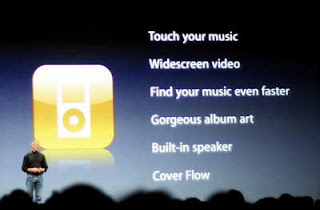
*Uses visuals effectively. Jobs doesn't clutter up his presentation visuals with a lot of words. In fact, the slide shown above probably had the most words of any slide he used. Most of his slides have such illuminating reading as 2.0B (the number of iTunes songs sold to date), or "Ads". Without a lot of reading to do, the audience listens to Jobs more, giving the words he says more impact. Jobs also uses demos effectively; all of them use very simple examples rather than complicated ones. Why simplicity? Because simple ideas are easier to convey and easier for the audience to absorb.

*Focuses on the problem he's solving in detail. Watch Jobs' first 7 or 8 minutes of the iPhone introduction (starting about 26 minutes in and running until 33 minutes). All of that time he spends setting up why smartphones are dumb and clunky. He doesn't even talk about his solution to the problem until he's told the audience no fewer than three times what criteria a successful product in this market must have. And amazingly, the product he introduces has exactly those criteria. It's not only an effective marketing technique, but it creates drama and tension where there would be none otherwise.

*Says everything three times. Jobs always introduces new ideas first as a list, then he talks about each member of the list individually, and then he summarizes the list later. And, he always uses exactly the same words each time. A great example is the three functions that the iPhone has: an iPod, a phone, and a revolutionary Internet communicator. Every aspect had its own section of the keynote, and its own icon that kept being repeated. He even got the audience to chant the three items sequentially with him over and over. The result: even listeners who aren't paying attention get the message.

*Tells stories. At one point late in the presentation, Jobs' slide advancing clicker failed. He switched to the backup, and it wasn't working either. So what did he do? He told a story about how he and Steve Wozniak build a TV jammer and used it in college TV rooms to stealthily mess up TV signals. The story had nothing to do with the presentation, but it kept the audience laughing and amused while the backstage crew fixed the problem. Yet, the story fit beautifully into the larger iPhone story overall.

*Isn't afraid of the dramatic pause. When Jobs switches topics or is about to say something important, he doesn't rush into it. Often, he will go to the side of the stage and grab a drink of water. Or, he'll just stand to the side of the stage and say something like, "Isn't that amazing?" and just wait. The pauses both keep the audience from getting tired out and allows them to absorb what he has said. And more importantly, they create drama and anticipation for what is to come.

*Uses comparisons to demonstrate features. When Jobs has a feature he really wants people to remember, he always compares it to something else. In the iPhone introduction, he compared the iPhone with other smartphones. When he introduced the iPod nano, he compared it with other flash players. Comparisons allow him to emphasize the unique selling propositions of his products and paint the competitive landscape on his terms. This one feature of Jobs' presentations puts his presentations head and shoulders above others.


If anyone needs more convincing of how much of a difference presentation technique makes, just contrast Cingular CEO Stan Sigman's presentation beginning at 1:34:50 in with Jobs'. Despite his professionally written content, his presentation just falls flat on too many words and not enough life. The audience starts clapping at once point just to try to convince him to cut it short. Ouch.


Apple has built its reputation by sweating the details for its customers. Jobs does the same for his audiences. Few companies will effectively compete against Apple until they start doing the same. Until then, Jobs' reality distortion field will be as powerful as ever.

Breaking The Rules

Shock! Horror! Jobs Breaks All The Rules

The much anticipated Apple iPhone was announced at Macworld
by Steve Jobs. While I'm not going to comment on how cool the iPhone is, I did want to mention Mr Jobs performance.

As public speakers go Steve certainly knows how to deliever a message (I will admit he does have a great AV setup to add just a little sparkle) . But, here's the thing - he breaks ALL the rules!...because HE can.

Steve has built his career on being a maverick, on doing things differently. The truth is that most of the rest of us don't have the liberty to be like Steve...

Check out how 'not' to do it ar the Macworld site

Wednesday, January 10, 2007

Killer Powerpointing

Guy Kawasaki is a dynamic presenter and public speaker not to mention evangelist. He has established what he calles his 10/20/30 Rule of Powerpoint - "a PowerPoint presentation should have ten slides, last no more than twenty minutes, and contain no font smaller than thirty points."

10 Slides (or less)
20 Minutes
30 Font Size (or bigger)

Simple... and brillant!

Can You See His Point?

This is a very cool video of the masterful Doug Jefferys on public speaking and killer presentation skills. He's right on the money and entertaining too!

Notice his 'pointing' technique (and the story about Bill Clinton) - this has been adopted by many speakers (British PM Tony Blair used this too). It's a compromise between a (finger) point to add emphasis and the thumbs-up gesture. Enjoy.


Keep It Simple

Here's a great article with some simple tips to making better presentations and more being more effective in your public speaking...

Better Public Speaking & Presentation- Ensure Your Words Are Always Understood

Think of the last really memorable talk or presentation that you attended. Now, was that easy to do, or did you really have to rack your brains to remember one?Sadly, too many presentations are easy to forget. And that's a big problem because the only reason the presenter gave the talk was to communicate something to you!

However, there are three basic things that you can do to ensure that your verbal messages are understood - and remembered - time and time again.

Although somewhat obvious and deceptively simple, these are:

*Understand the purpose of the presentation
*Keep the message clear and concise
*Be prepared
*Be vivid when delivering the message
*Understand what you want to achieve:
*Before you start working on your talk or presentation, it's vital that you really understand what you want to say, who you want to tell and why they might want to hear it. To do this, ask yourself: Who? What? How? When? Where? Why?

Who are you speaking to? What are their interests, presuppositions and values? What do they share in common with others; how are they unique?

What do you wish to communicate? One way of answering this question is to ask yourself about the ‘success criteria’. How do you know if and when you have successfully communicated what you have in mind?

How can you best convey your message? Language is important here, as are the nonverbal cues discussed earlier. Choose your words and your nonverbal cues with your audience in mind. Plan a beginning, middle and end. If time and place allow, consider and prepare audio-visual aids.

When? Timing is important here. Develop a sense of timing, so that your contributions are seen and heard as relevant to the issue or matter at hand. There is a time to speak and a time to be silent. ‘It’s better to be silent than sing a bad tune.’

Where? What is the physical context of the communication in mind? You may have time to visit the room, for example, and rearrange the furniture. Check for availability and visibility if you are using audio or visual aids.

Why? In order to convert hearers into listeners, you need to know why they should listen to you – and tell them if necessary. What disposes them to listen? That implies that you know yourself why you are seeking to communicate – the value or worth or interest of what you are going to say.

Keep it Simple:
When it comes to wording your message, less is more. You're giving your audience headlines. They don't need to and are usually not expecting to become experts on the subject as a result of hearing your talk.

If you're using slides, limit the content of each one to a few bullet points, or one statement or a very simple diagram.

Be Prepared:
Preparation is underrated. In fact, it is one of the most important factors in determining your communication successes. When possible, set meeting times and speaking and presentation times well in advance, thus allowing yourself the time you need to prepare your communications, mindful of the entire communication process (sender, message, channel, receiver, feedback and context). By paying close attention to each of these stages and preparing accordingly, you ensure your communications will be more effective and better understood.

Of course, not all communications can be scheduled. In this case, preparation may mean having a good, thorough understanding of the office going-ons, enabling you to communicate with the knowledge you need to be effective, both through verbal and written communications.

Unforgettable Delivery:
Your delivery of your speech or presentation will make or break it, no matter how well you've prepared and crafted your clear, concise message. Some useful tips for keeping your presentation vivid include:
Use examples to bring your points to life
Keep your body language up-beat - don't stay stuck behind a rostrum
Don't talk to fast. Less is more here too. Pauses are effective.
Use a variety of tones of voice
Use visual aids.

http://www.mindtools.com/CommSkll/PublicSpeaking.htm

Summary:

Be prepared! According to Mark Twain "It usually takes more than three weeks to prepare a good impromptu speech."

Understand the role and makeup of each of the following elements:

Who? - Audience
What? -Message

How? - Context
When? - Timing
Where? - Setting
Why? - Purpose

Tuesday, January 9, 2007

Have You Got The Wrong Look?


I often meet people on my travels who tell me how their appearence means they'd never be taken seriously as a public speaker.

Given the opportunity, they'll elaborate with great gusto about how they have too many handicaps stacked against them - not the right look, too fat/too thin, to tall/to short, big teeth, floppy hair...and on and on it goes!

So, hands up who has heard of Anthony Robbins? Big tall, big teethed, formerly of the floppiest (and considerably goofy looking) hair I've ever seen, Tony didn't come out of the womb with all guns blazing.

What about Hitler? He was, short, had a ridiculous mustache and none too many good hair days, not to mention some bad ass pants.

Gandhi? Small, skinny, wearing an over sized diaper and NO hair to speak of!

Well, I could go on here, but I'm guessing you've got the point...